.png?width=284&height=80&name=Penta_Logo_1CBD83%201%20(1).png)
 January 20, 2026
 Bryan DeAngelis
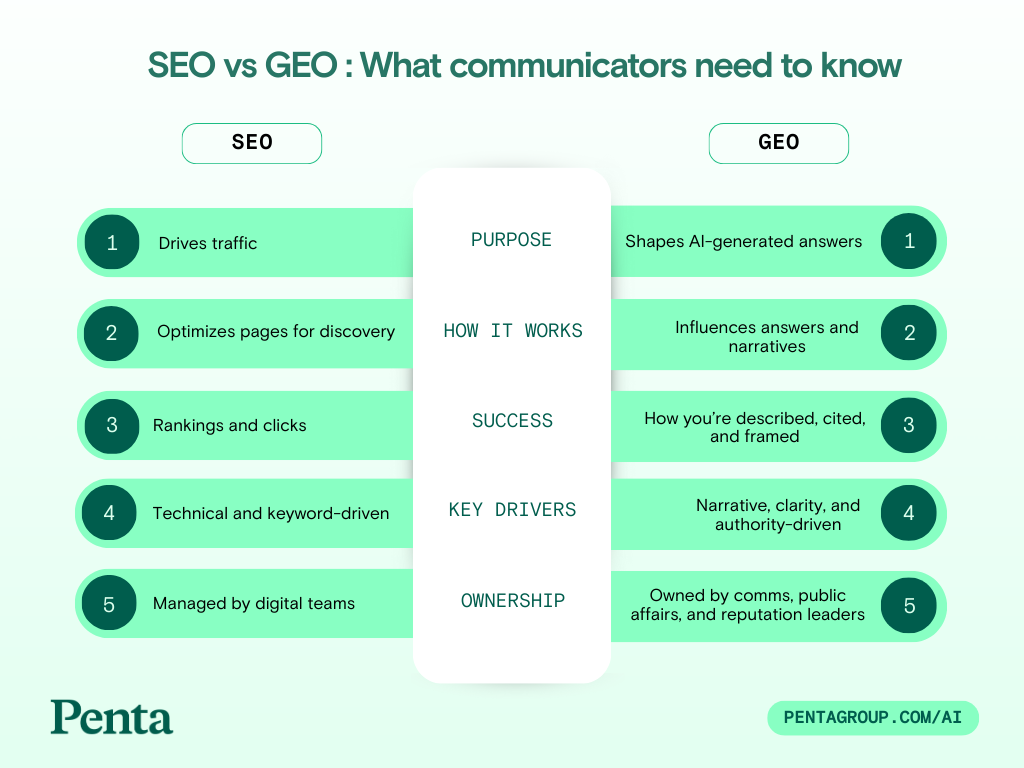
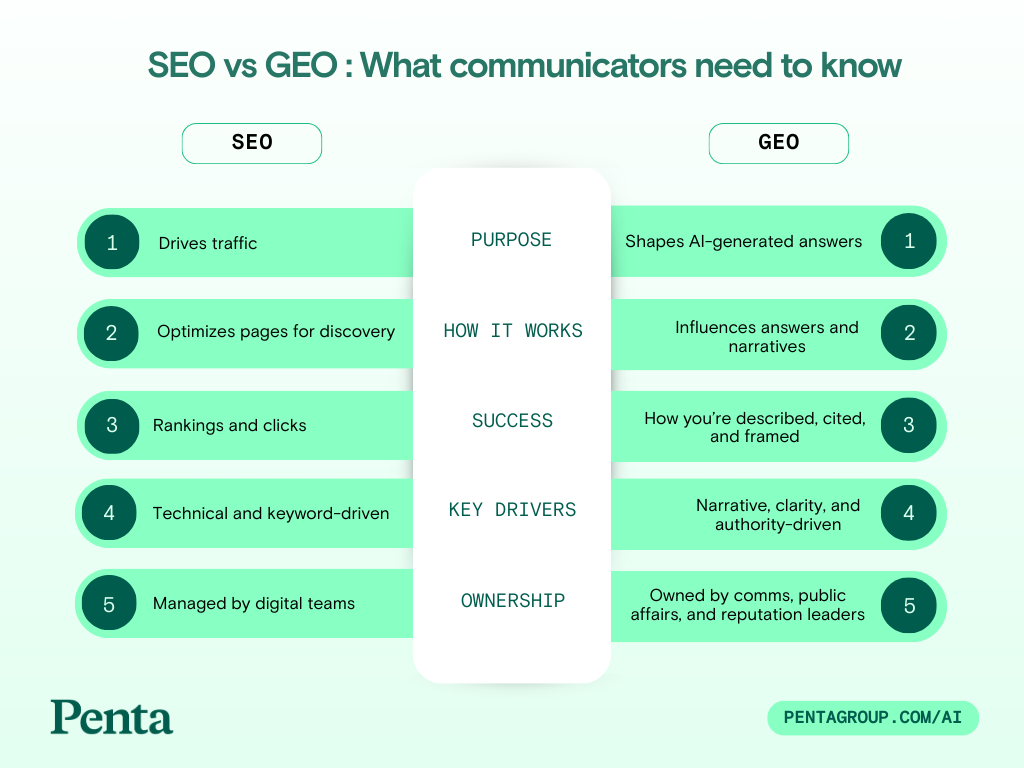
For more than two decades, Search Engine Optimization (SEO) has been a focus for organizations looking to have their website rank higher in a list of links. Keywords, backlinks, page speed, metadata were all signals designed to help influence how search engines rank your page among a set of different results.
With generative engine optimization (GEO), that model is evolving, very quickly.
Today, large language models like ChatGPT, Gemini, Claude, and Perplexity don’t return lists of links. They ingest massive amounts of content, detect patterns across sources, and generate a single AI answer or overview that feels authoritative. The impact of these AI answers and overviews is driving what is currently called ‘zero-click search’ and data from Similarweb shows that upwards of 80% of Google searches with AI Overviews result in no click throughs at all.
It can be helpful to think about this in terms of fundamental questions. The new models are not asking “Which page ranks highest?” They are asking “What is the most consistent, credible story across the web?”
What’s often overlooked is that the story changes depending on who’s asking. Policymakers probe risk, compliance, and market impact. Investors look for governance, stability, and long-term value. Employees ask about culture and leadership. Customers focus on trust and usability. Generative models reflect those differences in real-time — even when the underlying subject is the same.
That’s why GEO can’t be approached as a one-size-fits-all optimization problem and presents both massive complexity and opportunity for organizations.
Organizations need to be deliberate about which questions their content answers and for whom. Our audits consistently show that when companies lack clear, consistent, owned content on issues that matter to their stakeholders, the models default to third-party or comparative sources. In other words, when organizations are cited directly, sentiment improves and they’re absent or their perspective is absent, other sources are sourced to define the narrative.
GEO requires seeing AI as a stakeholder mediator, not just a channel. This means that "writing for LLMs" is actually about communicating the way some of the most effective organizations do: Consistently, clearly, openly and in language that people can understand and relate to.
This also means that communications teams within organizations bear an even bigger responsibility for GEO results than they did when SEO ruled search. GEO cuts across communications, public affairs, investor relations, legal, and digital because AI systems synthesize signals from all of them.
At Penta, we approach GEO through explicit stakeholder lenses: testing how organizations appear to customers, investors, employees, and policymakers across platforms, issues, and competitors. The goal isn’t just visibility; it’s coherence. The goal is a living playbook to help ensure that what an AI model “knows” about an organization is aligned, defensible, and current.
If you’re not deliberately shaping how AI explains your organization to policymakers, investors, employees, and customers, you’re letting the system do it for you.
Get the whitepaper
Listen to the podcast