.png?width=284&height=80&name=Penta_Logo_1CBD83%201%20(1).png)

 June 2, 2026
 Andre Christianson,
Lloyd Miller
Andre Christianson,
Lloyd Miller
On Tuesday, voters across California, Iowa, Montana, New Jersey, New Mexico, and South Dakota will cast ballots in primaries for 79 U.S. House and Senate races. For most political observers, the story will be isolated horse races: who survives, who stumbles, what it means for the general election. But here at Penta, we know Tuesday's primary, and those to come, provide important insight for how the next Congress will engage on specific issues. So, we built a new AI-enabled model to find out what it might mean for Artificial intelligence.
Why AI?
AI is in some ways an obvious choice, but our fresh-from-the-field proprietary policymaker research, which polls U.S. federal policymakers and senior staff across Congress and the administration, indicates the double-click is worth it. This data, from our most recent 2026 survey, shows AI as far and away the top issue cited as "in the greatest need of additional federal regulation."
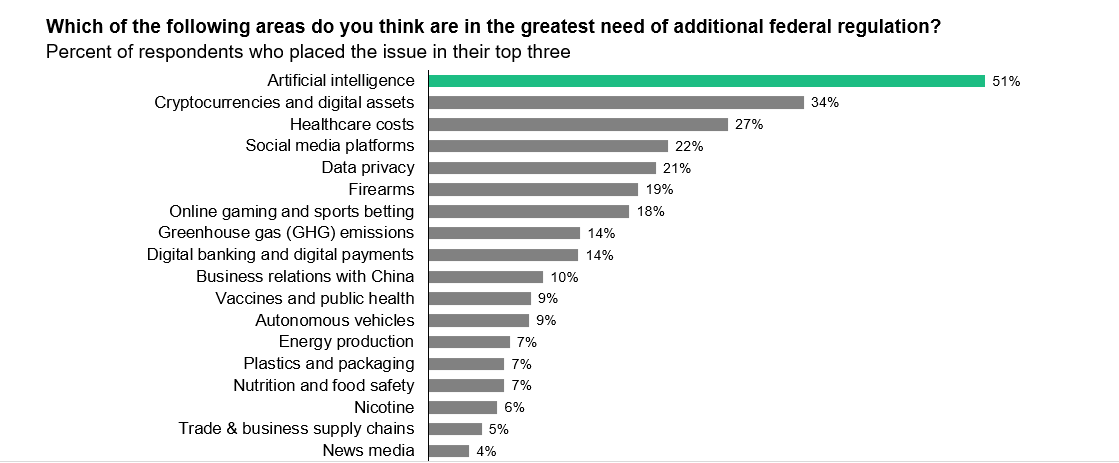 Survey conducted by Penta Group between February 3 and April 20, 2026, among 2,060 U.S. federal policymakers and senior staff across Congress, the Administration, federal agencies, and key opinion formers.
What a survey of sitting members doesn't tell us is whether the next Congress will be more or less inclined toward regulation than the current one.
The method
To get an indication of what the June 2 primary will mean for AI regulation, we identified 161 viable* candidates and scored each on AI policy ideology using a -100 to +100 scale, with "shut it down" at one end, and "unleash the AI" at the other. Scores reflect each candidate's stated positions, public record, and stated legislative priorities, drawn from campaign websites, press coverage, and social media.
We then ran 10,000 Monte Carlo simulations (a technique to run thousands of scenarios to show the range of likely outcomes), weighing each candidate's probability of winning their primary and general election based on Polymarket prediction markets and Cook Political Report ratings. The result: a distribution of where the incoming members from these races are likely to land on AI.
* We define Viable candidates as incumbents and anyone running in a primary with an RCP polling average > 40% in a 2 person race, or > 25% in a primary with 3 or more candidates.
The what
The mean AI ideology score for incoming members from June 2 races is -15. Remember that -100 to +100 scale? This means the likely crew coming to Congress from the June 2 states has some "shut it down" vibes. Of note: the 90th percentile range runs from -20 to -10. The upshot: there is essentially no scenario in which Tuesday's primaries produce a cohort with net positive views on AI.
The so what
It's important to note that the composition of Tuesday's ballot tilts heavily Democratic. Of the 161 viable candidates, 111 are Democrats, and 67 of those are in California, a state well known for its regulatory bent. So, yes, the Democratic skew pulls the overall outcome solidly negative. Does this matter, you ask? Possibly.
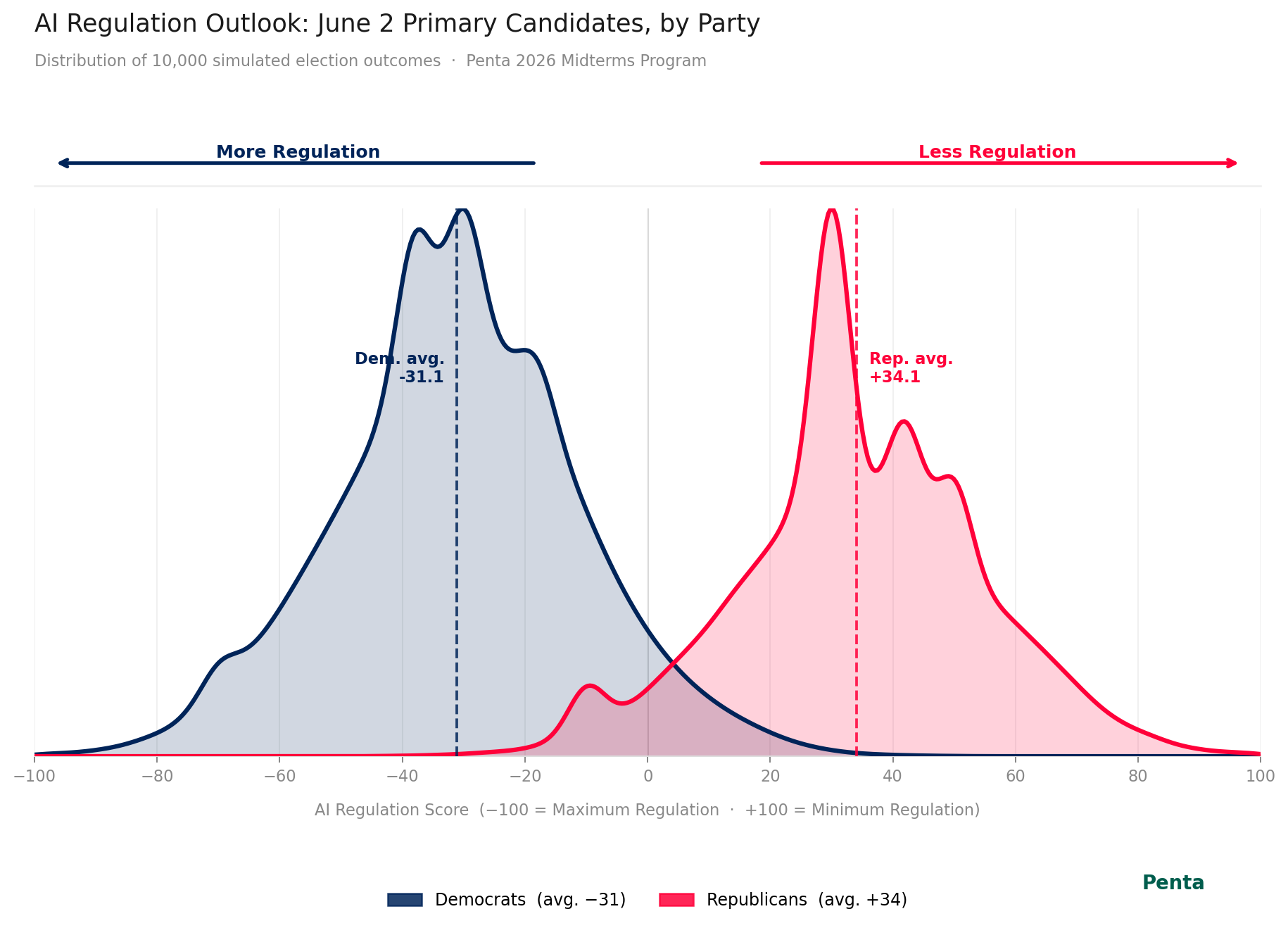
The partisan divide is sharp. Democratic candidates in our dataset average a -31 on the scale; Republicans average +34. Democrats have consistently pushed for stronger AI guardrails, while many Republicans have resisted federal intervention. But the gap is significant.
Also significant is the variation Penta's policymaker research found on AI by party. The Democrats, our more pro-regulation cohort, are less likely to use AI daily than Republicans and more than twice as likely to avoid AI entirely.
What's next
It'll be worth watching how Republicans trend over the primary season. President Trump still hasn't released a much-anticipated executive order on AI, and the angst about data centers is bipartisan. Seeing if the partisan divide converges over the rest of the primary season is something Penta will be keeping its eye on.
For companies watching Washington, the question is whether they are prepared to engage authentically with a new Congress with one of the largest freshman classes in history.
Lloyd Miller is the Head of Product at Penta Group. Andrea Christianson is a Partner and leads Penta's AI Practice. This analysis is a part of Penta's 2026 Midterms Program that leverages Penta's proprietary data platform to help clients understand how the next Congress will view their priority issues to stay ahead and shape what's next.