.png?width=284&height=80&name=Penta_Logo_1CBD83%201%20(1).png)

 June 23, 2026
 Conall McDevitt,
Chris Mehigan
Conall McDevitt,
Chris Mehigan
The UK's under-16 social media ban is not a policy experiment. It is the opening move in a structural, multi-jurisdictional regulatory shift that will reshape how platforms, brands, and advertisers operate for the next decade.
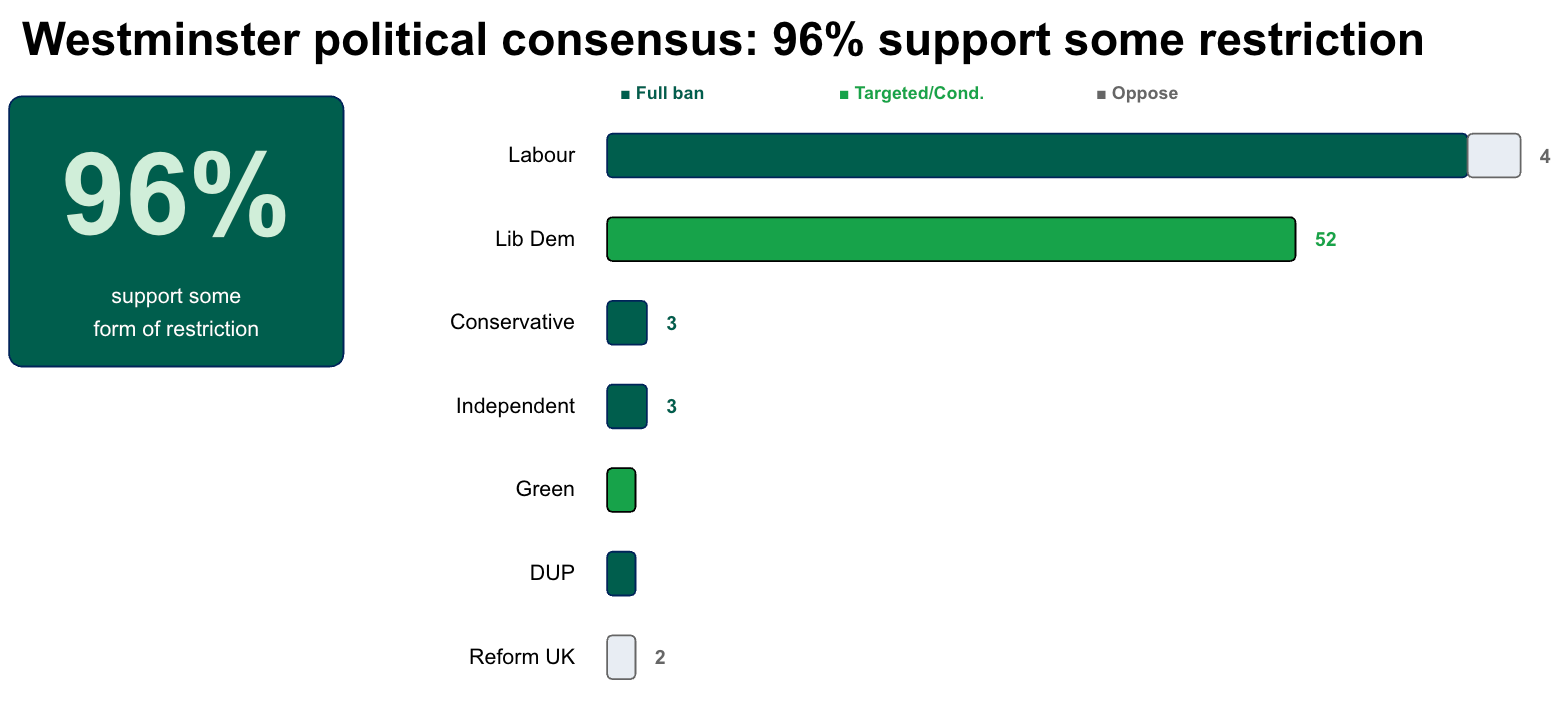
On June 15, the UK government announced a full ban on social media for children under 16, with legislation expected before Christmas and enforcement beginning in spring 2027. The announcement came after a public consultation that drew more than 116,000 responses, a parliamentary process that saw the Commons reject statutory ban amendments three times before the government reversed course, and a political environment in which 96% of Westminster MPs now support some form of restriction.
The policy moved from "not the right approach" to government-backed policy in under six months. Why?
The Ratchet Only Moves One Way
The conventional read on these bans is that they are blunt instruments, difficult to enforce, and likely to be softened in implementation. That reading is probably correct on the merits: Australia's ban, in force since December 2025, has seen over five million accounts removed from platforms, but many teenagers are still accessing platforms through workarounds, no fines have been issued, and the eSafety Commissioner is still working through the mechanics. Critics, including the Electronic Frontier Foundation, argue that the UK ban will cause more harm than it prevents by pushing young people toward less-regulated spaces and requiring age-verification systems that create new privacy risks.
These are real concerns. But they are not the concerns that will determine how this plays out from a commercial and regulatory view.
What matters is not whether the bans work as advertised. It is that the political logic behind them is self-perpetuating. Ireland's 2004 workplace smoking ban was dismissed as unenforceable, but by 2012, most democracies had followed. No jurisdiction that introduced a plastic bag levy reversed it; instead, the scope consistently expanded. Child protection operates within a similar frame: Once a government has legislated on it, the political cost of reversal is prohibitive, and the pressure on every adjacent jurisdiction to follow is immediate. The question asked in every parliament that hasn't yet acted is the same: "Why are we behind Australia?"
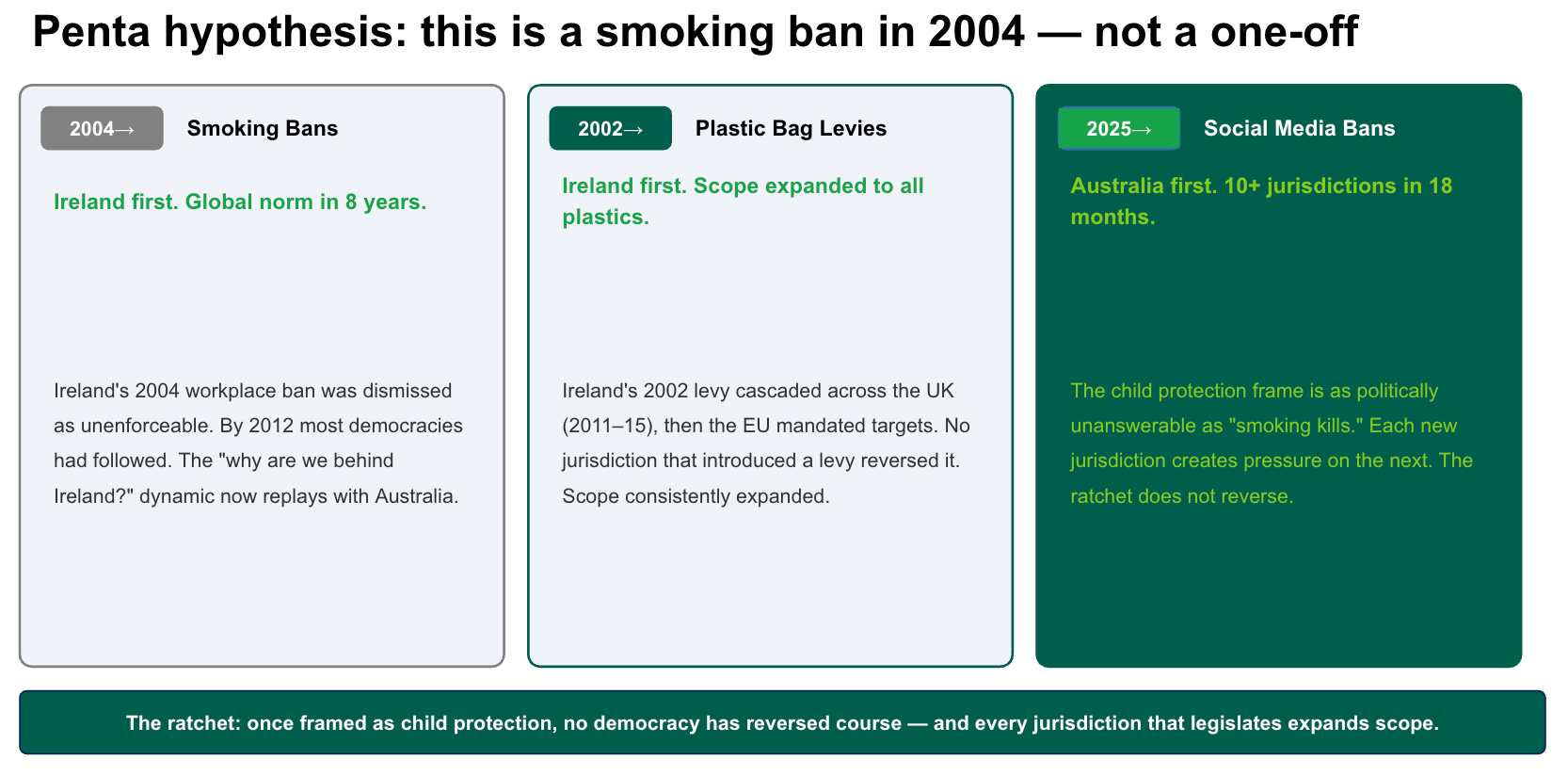
Ten or more jurisdictions are now acting, from Norway and Greece to Spain and France, with the EU making children's online safety its headline priority for the second half of 2026. A European Commission proposal for a harmonised minimum age, likely 15 or 16 across all 27 member states, is in active development. The African Union adopted a Child Online Safety Policy in February 2024 and is targeting a continental model law by the end of 2026. In the United States, federal action remains constrained by the First Amendment, but eight states have enacted restrictions and more than 25 have introduced legislation. The Kids Off Social Media Act (S.278) is bipartisan and out of the Senate committee. Each jurisdiction that legislates broadens what the next one inherits.

The Scope Expands With Every Cycle
The proposed UK ban is an access restriction, but the regulatory architecture being built around it is considerably wider. Features viewed as harmful, including algorithmic recommendation systems and infinite scroll, will be considered in the overall proposal. AI companion chatbots are set at 18 and above, closing a gap in the existing Online Safety Act. Ofcom has until October 2026 to design technical standards for age verification, but it will not be starting from scratch. The European Union is already ahead in this area: it launched its age-verification blueprint in July 2025, piloted it across several member states, and made the system available for adoption across the EU in April 2026. The European approach therefore provides a practical model that Ofcom could draw upon as it develops the UK's framework, one that is likely to be closely watched by other jurisdictions.
The EU’s current work on children’s welfare and social media is moving on three tracks: tighter enforcement of the Digital Services Act (DSA), a new age-verification framework, and a broader policy push on how minors use social media. The next concrete milestone is the Special Panel on child safety online, which will present recommendations to Commission President Ursula von der Leyen on 13 July 2026.
The Digital Fairness Act (DFA) is designed to sit alongside the DSA as the horizontal consumer‑protection piece that targets dark patterns, addictive design and influencer marketing, with a strong child‑protection angle; it is currently scheduled for publication by the Commission in Q4 2026.
With more than 450 million consumers, EU regulation has the capacity to establish global norms. As platforms adapt their systems to comply with EU requirements, those compliance measures are likely to become industry standards beyond Europe. The pattern is therefore consistent: access bans first, then design restrictions, and ultimately the harmonisation of regulatory expectations across jurisdictions.
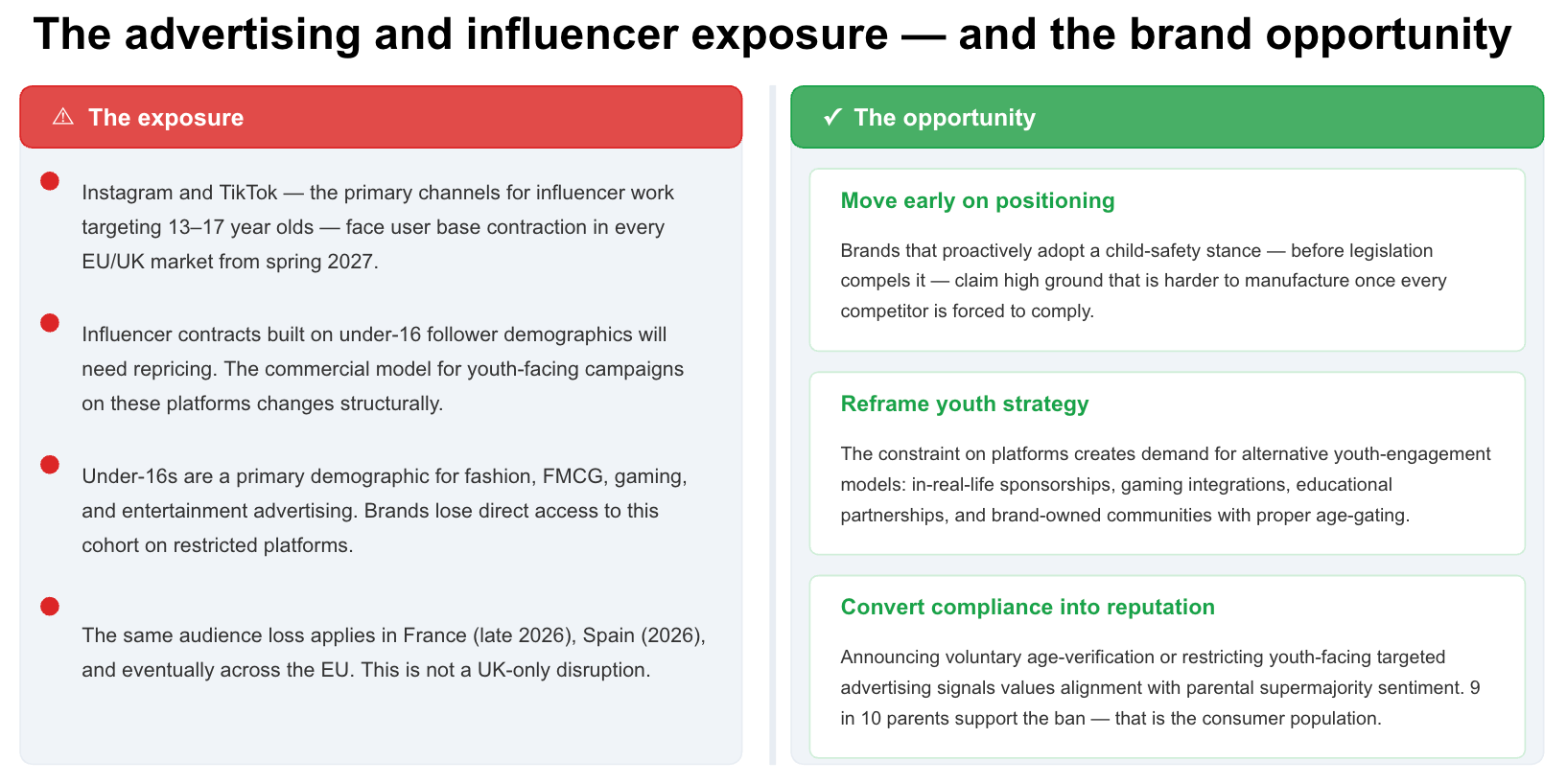
If your organisation has material exposure to youth audiences, the compliance horizon is already here. Age-verification obligations, algorithmic design restrictions, and advertising audience contraction are structural. Instagram and TikTok are the primary channels for influencer work targeting 13 to 17 year olds. From spring 2027, that user base will contract in every EU and UK market. Influencer contracts built on under-16 follower demographics will need repricing. The same audience loss applies in France, Spain, and eventually across the EU.
The Decision in Front of You
The organisations that navigate this well will not be the ones that wait for legislation to pass and then build compliance programs. They will be the ones that treat the period between now and when the architecture sets as the window it actually is.
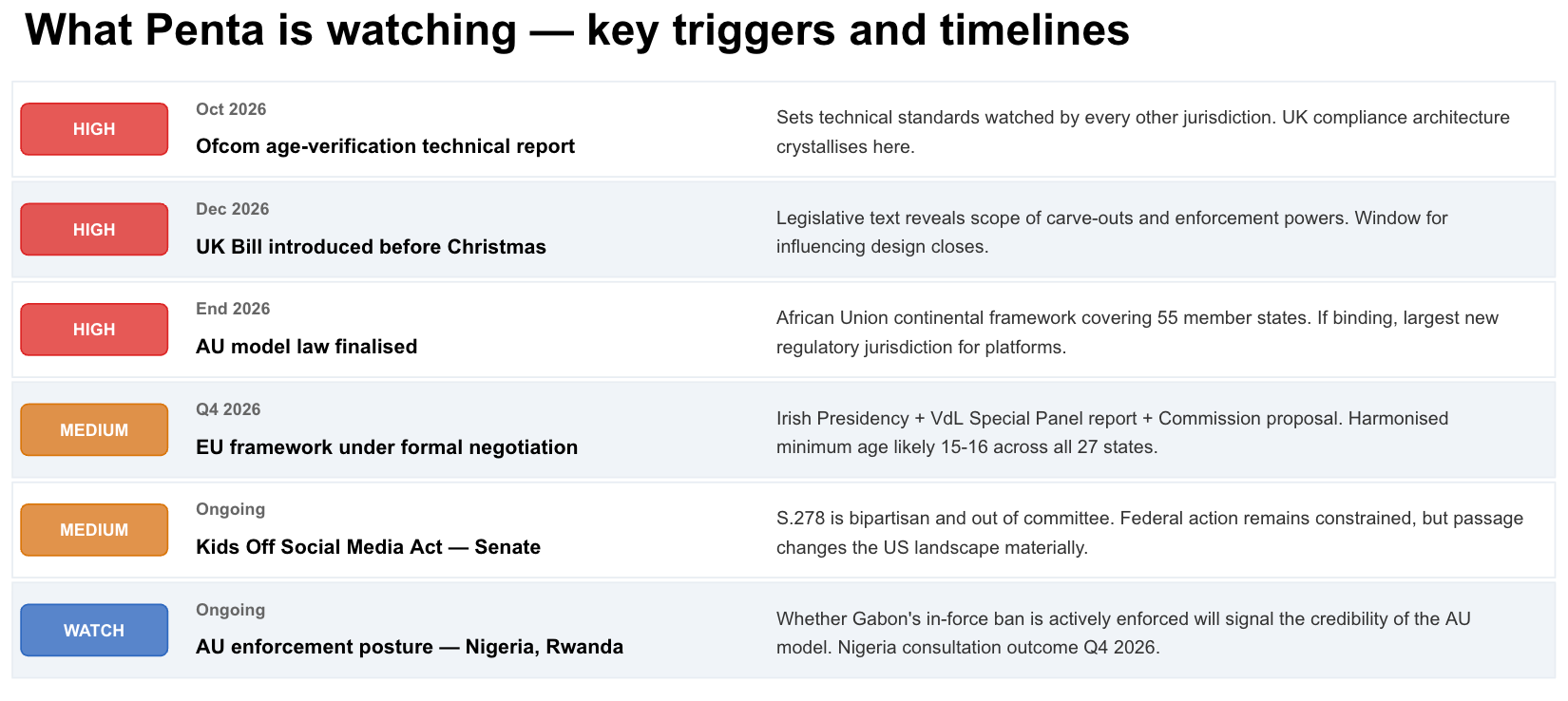
If you operate a platform, the Ofcom technical report in October is the most consequential near-term moment in the UK. The verification standards it sets will shape what compliance costs and how enforcement works. The Irish Presidency window, running through December, is where the EU framework takes shape. Carve-outs for messaging, educational content, and parental consent mechanisms are still in play.
If you lead communications or public affairs for a brand, the constraint creates an opportunity that closes the moment every competitor is forced to comply. Nine in ten parents — in other words, your consumer population — support the ban in every major democracy polled. Brands that proactively adopt a child-safety stance before legislation compels it can credibly claim high ground that is harder to manufacture once compliance is universal. The constraint on platforms also creates demand for alternative youth-engagement models: in-real-life sponsorships, gaming integrations, educational partnerships, and brand-owned communities with proper age-gating.
If your organisation's position has been to engage on the principle of these bans, whether on free speech grounds or parental responsibility, know that argument is not working in this environment. The child protection frame is morally dominant. The productive engagement now is on enforcement design: verification standards, carve-outs, timelines, and the practical mechanics of implementation.
The debate about whether these bans are good policy will continue for years. The debate about whether they are happening is over. The Ofcom technical report lands in October. The UK bill is introduced before Christmas. The EU framework moves into formal negotiation in the second half of 2026.
The organisations that act now, on positioning, engagement, and strategy, will have shaped the architecture. The ones that wait will inherit it.