.png?width=284&height=80&name=Penta_Logo_1CBD83%201%20(1).png)
 July 27, 2026
 David Cook
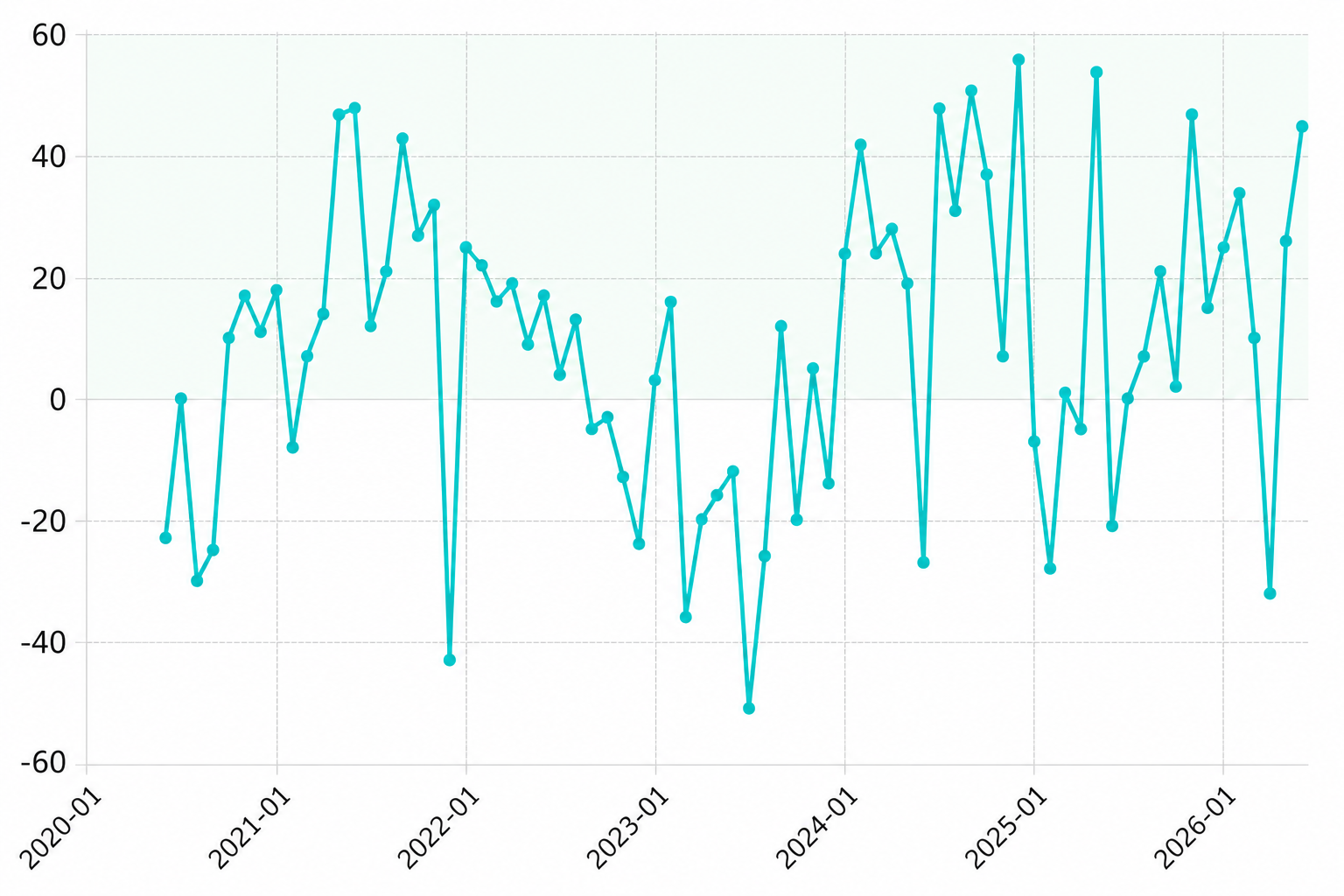
In Q2 2026, Penta’s UK Bank Sentiment Index remained in positive territory, but the sector’s reputation became more complex. The UK banking sector recorded a quarterly score of +16, down from +22 in Q1, suggesting that some of the momentum from the start of the year softened.
The Q2 results suggest that banks are increasingly being judged against broader reputational standards. Financial performance still matters, but it is not enough. Banks are also being judged on whether they can be trusted, whether they use technology responsibly, whether they remain accessible to customers, and whether they can explain how innovation is being used in the public interest.
That is particularly true when it comes to artificial intelligence.
UK Bank Sentiment Index over time
AI is becoming a reputation issue
Technology was one of the most visible issues influencing bank sentiment in Q2, with artificial intelligence emerging as a significant driver in its own right. AI is no longer simply an innovation story for banks. As is the case across a number of sectors, it is becoming a trust story.
AI can help detect fraud earlier, improve customer service, support credit and risk decisions, reduce operational friction and personalise products. But each of these benefits also creates a reputational test. Can customers understand how decisions are made? Is their data being used appropriately and safely? Are outcomes fair? And when something goes wrong, or a customer needs support, can they still reach a human?
That means banks’ use of AI will not be judged on productivity alone. Regulatory interest is only going to grow, as shown by the FCA’s recent review of the impact of AI on retail financial services. Customers, regulators, and policymakers will ask whether it is fair, secure, transparent, and properly governed.
A review of media activity suggests that AI is already highly visible, but not yet deeply negative. In Q2, artificial intelligence generated more than 10,000 articles, nearly double the level recorded in Q4 2025. At the same time, only 11% of AI coverage in Q2 was negative, compared with 87% for fraud and 64% for legal and regulatory issues. In other words, the AI narrative is still relatively open. Banks have a window to shape it around customer value, resilience, fraud prevention and accountability before it becomes defined by concerns around cost-cutting, exclusion or reduced access to human support.
For communications teams, the challenge is clear: Banks need to explain why AI benefits customers, how risks are governed, and where human accountability remains. Banks cannot assume that announcing investment in AI will automatically land as a positive innovation story. Without a connection to trust and customer value, some stakeholders may see it less as a route to better banking and more as a route to cost-cutting, job losses, or a worse customer experience.
A less polarised sector, but not necessarily a less risky one
One of the most notable shifts in Q2 was that the gap between the strongest and weakest performers narrowed. In Q1, there was a spread of around 62 points between the best and worst-performing banks. In Q2, that gap narrowed to around 45 points.
That may suggest a less polarised sector. But it should not be mistaken for a less exposed one. The Q2 issue data underlines this point. Mortgages were the most visible topic, followed by technology, trust, bank branches, artificial intelligence, legal and regulatory issues, and financial results.
Top issues influencing bank sentiment in Q2 2026
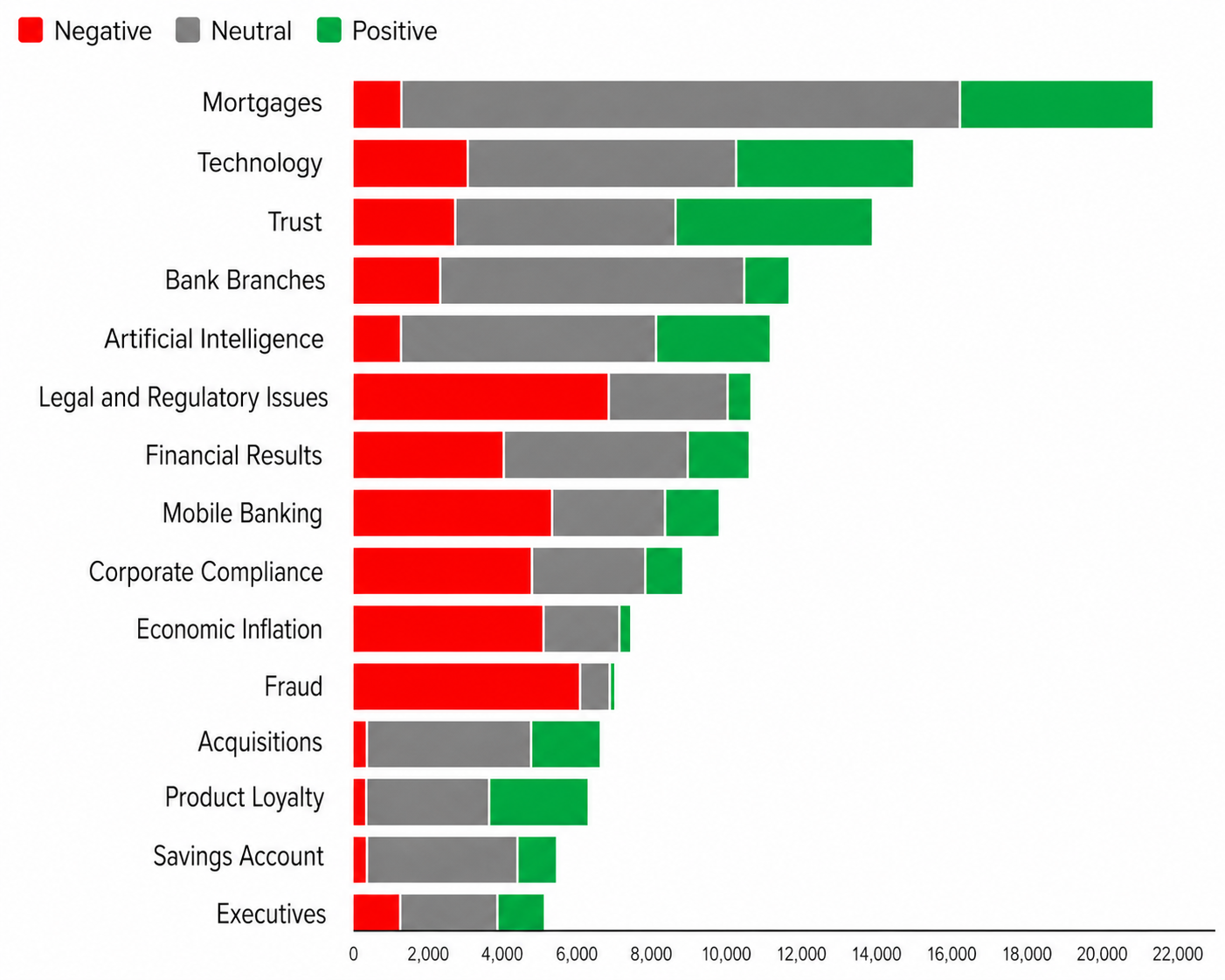
This mix shows how many different tests now shape bank reputation simultaneously, and why reputational risk is not always concentrated where visibility is highest. Lower-volume issues such as fraud, conduct, or regulatory scrutiny can carry greater weight than high-volume but largely neutral topics.
The strongest performers in Q2 included Tandem and Chase, which outperformed their long-term benchmarks. At the other end of the index, a number of more established banks tracked below their long-term averages.
The difference between these institutions is not simply whether they generated good or bad news. It is how clearly their narratives were understood, how much competing reputational noise surrounded them, and whether positive developments were reinforced or weakened by the wider context.
Trust is still the organising issue
The Q2 data reinforces a point that has run through previous editions of the Bank Sentiment Index: bank reputation is highly contextual. A bank announcing AI investment while also facing service concerns may not be seen as innovative. It may be seen as prioritising efficiency and profit over customers. A bank talking about digital transformation while closing branches may not be seen as modernising. It may be seen as becoming less accessible. The framing of any individual story is shaped by everything else happening around it.
This is why trust remains the organising issue. AI, mortgages, branch closures, mobile banking, fraud, financial results and regulation may appear to be separate topics. In reputational terms, they are connected by a single question: do customers, regulators, investors and policymakers believe banks are using their strength responsibly?
Q2 did not produce a single dominant crisis for the sector. Instead, it showed a more dispersed and arguably more difficult reputational environment, with risks spread across commercial uncertainty, regulatory scrutiny, technology governance, consumer finance and legacy conduct. That makes the landscape harder to manage through traditional media monitoring or campaign-by-campaign communications planning.
What to look for in Q3
The key question for Q3 is whether banks can turn stronger sentiment into more durable trust. That means being clearer about the link between technology and customer benefit, while recognising where positive stories may be undermined by other narratives around access, fairness, resilience, or conduct.
For communications and leadership teams, the practical challenge is to understand not only whether sentiment is rising or falling, but why. The lesson from Q2 is that reputation is not just a measure of visibility or tone. It is a measure of whether an institution’s actions, messages and stakeholder expectations are aligned.
Penta’s UK Bank Sentiment Index
Penta’s UK Bank Sentiment Index tracks how sentiment towards the UK’s 20 largest banks, and their reputations, are shifting over time. It is benchmarked to a long-term average of zero, with positive scores indicating above-average sentiment and negative scores pointing to below-average sentiment or potential reputational pressure. The data can show where individual firms sit against peers, which issues are driving positive and negative sentiment, and what can be done to strengthen reputation, manage risk and improve strategic positioning.