.png?width=284&height=80&name=Penta_Logo_1CBD83%201%20(1).png)
 December 3, 2025
 Penta
Penta
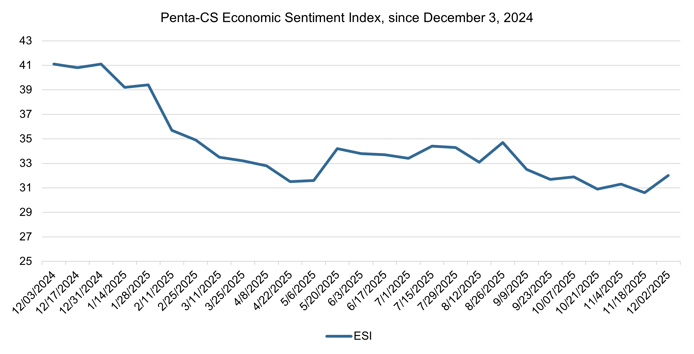
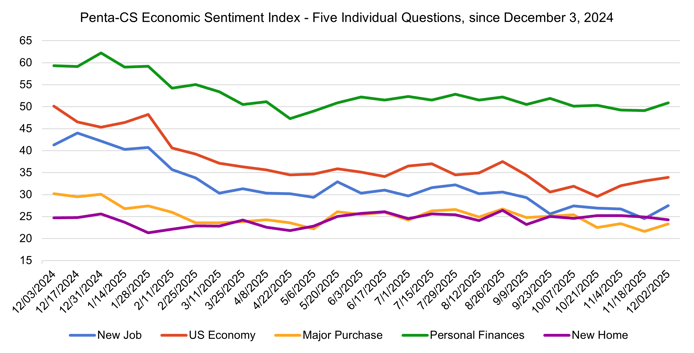
Four of the ESI’s five indicators increased during this period. Confidence in finding a new job increased the most, climbing 3.0 points to 27.5.
—Confidence in personal finances increased 1.8 points to 50.9.
—Confidence in making a major purchase increased 1.7 points to 23.3.
—Confidence in the overall U.S. economy increased 0.8 points to 33.9.
—Confidence in buying a new home decreased 0.6 points to 24.3.
Following the end of the government shutdown, federal statistical agencies have begun issuing key economic data from the past few months after several months’ delay due to the lapse in government funding.
The Bureau of Labor Statistics (BLS) issued the delayed September Jobs Report on November 20, which showed that the economy added 119,000 jobs—well above the 50,000 predicted by economists—and the unemployment rate ticked up to 4.4 percent. Later, on November 25, BLS released the September Producer Price Index (PPI), finding that prices for final demand goods, excluding food, energy, and trade services, increased by 0.1 percent in September and 2.9 percent annually. Also on November 25, the U.S. Census Bureau released the estimates of U.S. retail and food services sales in September. Overall, retail and good sales were $733.3 billion, up 0.2 percent from August, and up 4.3 percent from September 2024.
Data from the National Association of Realtors (NAR) showed that existing home sales in October rose 1.2 percent from the previous month to a seasonally adjusted annual rate of 4.1 million, its highest level since February. Year-over-year sales increased 1.7 percent. “Home sales increased in October even with the government shutdown due to homebuyers taking advantage of lower mortgage rates,” said NAR Chief Economist Lawrence Yun.
On December 9 and 10, the Federal Reserve (Fed) will hold the final FOMC meeting of 2025 to determine whether to reduce interest rates for the third time this year. A Wall Street Journal analysis found that FOMC voters are divided on the path forward for monetary policy. This is due, in part, to the dearth of timely economic data caused by the government shutdown. Following the last FOMC meeting, Fed Chair Jerome Powell likened the lack of economic data to “driving in the fog” and stated that a December cut is “not a foregone conclusion.”
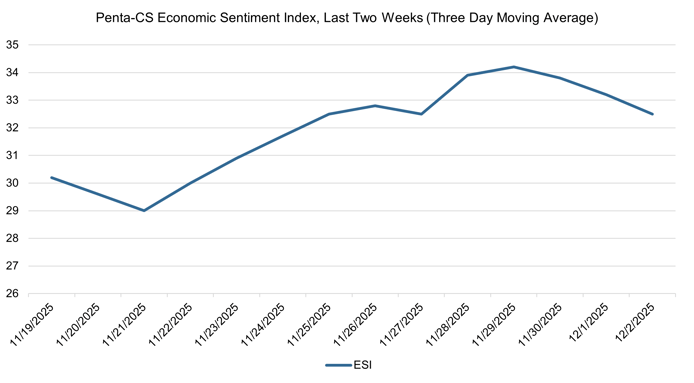
The ESI’s three-day moving average began this two-week stretch at 30.2 on November 19. It then decreased, falling to a low of 29.0 on November 21. The three-day moving average then trended upward, rising to a high of 34.2 on November 29 before dipping to 32.5 on December 2 to close out the session.
The next release of the ESI will be on Wednesday, December 17, 2025.