.png?width=284&height=80&name=Penta_Logo_1CBD83%201%20(1).png)
 July 1, 2026
 Penta
Penta
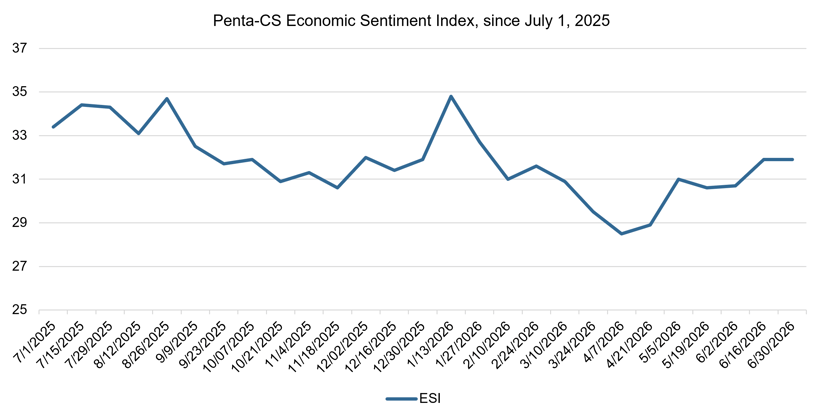
The latest biweekly reading of the Penta-CivicScience Economic Sentiment Index (ESI) remained at 31.9 as consumers faced a complicated economic environment marked by steady interest rates, stubborn inflation, solid retail spending, and renewed tariff threats.
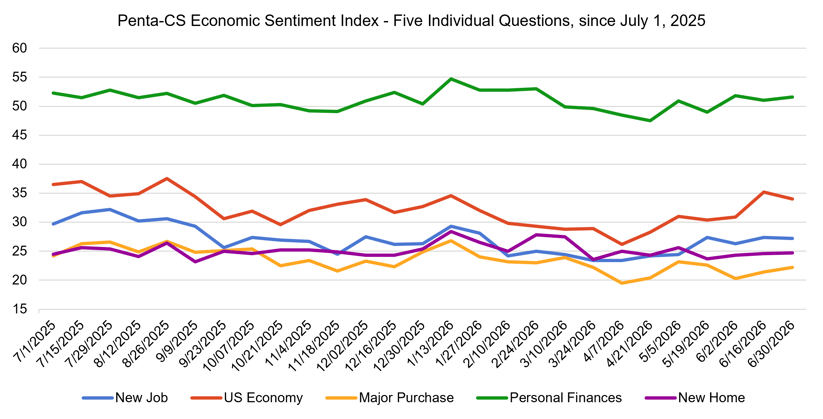
Three of the ESI's five indicators increased during this period. Confidence in making a major purchase increased the most, rising 0.8 points to 22.2
—Confidence in personal finances increased 0.6 points to 51.6.
—Confidence in buying a new home increased 0.1 points to 24.7.
—Confidence in finding a new job decreased 0.2 points to 27.2.
—Confidence in the overall U.S. economy decreased 1.2 points to 34.0.
The Federal Reserve held the federal-funds rate steady at 3.5 to 3.75 percent at its June meeting, marking the fourth meeting in a row without a change to rates. The 12–0 decision was the Federal Open Market Committee's (FOMC) first unanimous vote since June 2025 and the first vote under new Fed Chair Kevin Warsh.
Warsh put his imprint on the FOMC statement by streamlining it considerably, reducing much of the typical explanation for the rate decision and eliminating entirely any future signal about the Fed's policy path. While the committee’s updated dot plot signaled the possibility of a rate hike this year, Warsh did not submit his own outlook, underscoring his belief that the Fed should not commit itself to a specific policy path.
The core personal consumption expenditures (PCE) price index rose to its highest level since 2023, increasing 0.3 percent in May and 3.4 percent year-over-year. This is contrasted with U.S. retail sales data which increased 0.9 percent in May 2026, up from a revised 0.4 percent in April and 6.9 percent year-over-year. Together, these indicators suggest a complicated environment, with persistent underlying price pressures that remain over the Fed's 2 percent inflation goal, and resilient consumer spending bolstered by tax refunds.
U.S. President Donald Trump threatened to impose a 100 percent tariff on European countries that impose a digital services tax on U.S. companies. In a Truth Social post, the President stated, "This TARIFF will supersede Trade Deals made with the Country, whether implemented, signed, or not. Additionally, the 100% TARIFF will be immediately imposed, if they proceed." This threat came the day after the Council of the European Union voted to remove import tariffs on many U.S. goods. On President Trump's threat, a European Commission spokesperson stated, "Unilateral measures targeting such legitimate policies are unjustified. If pursued, the EU will respond swiftly and decisively to defend its rights and regulatory autonomy."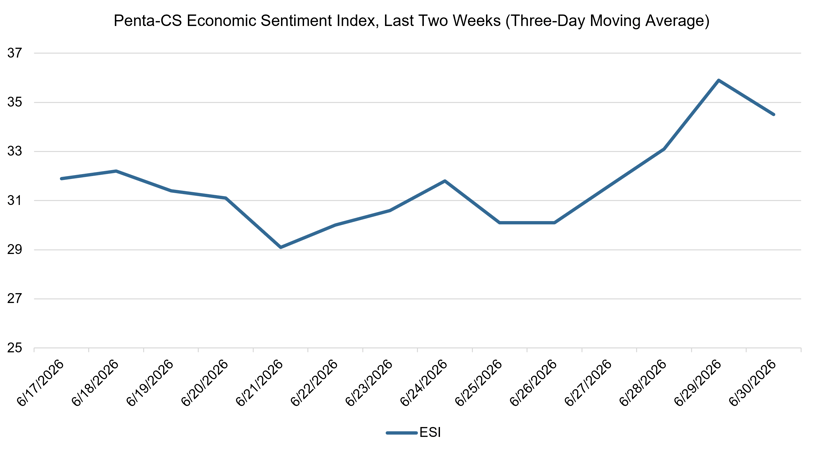
The ESI’s three-day moving average showed a choppy but ultimately positive trajectory over the two-week period. It began the two-week stretch at 31.9 on June 17, increased slightly, then fell to a low of 29.1 on June 21. The three-day moving average then trended upward, rising to a high of 35.9 on June 29 before falling to 34.5 on June 30 to close out the session.
The next release of the ESI will be on Wednesday, July 15, 2026.