.png?width=284&height=80&name=Penta_Logo_1CBD83%201%20(1).png)
 September 23, 2026
 Penta
Penta
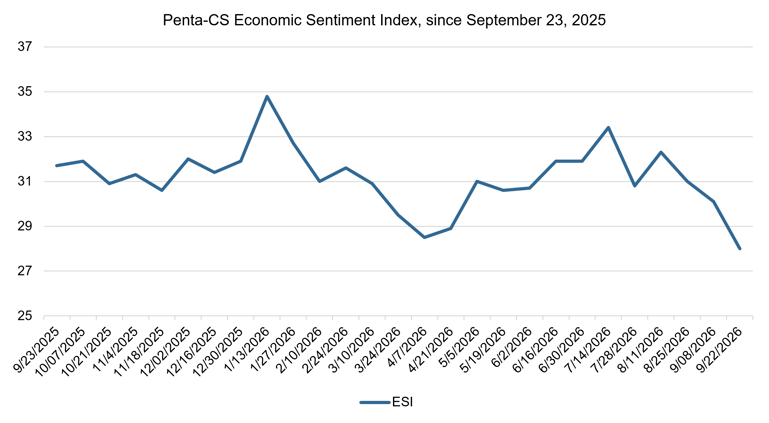
The latest biweekly reading of the Penta-CivicScience Economic Sentiment Index (ESI) decreased 2.1 points to 28.0, its lowest level since the index began in 2013, as the Federal Reserve raised interest rates, mortgage rates climbed, and oil prices remained elevated.
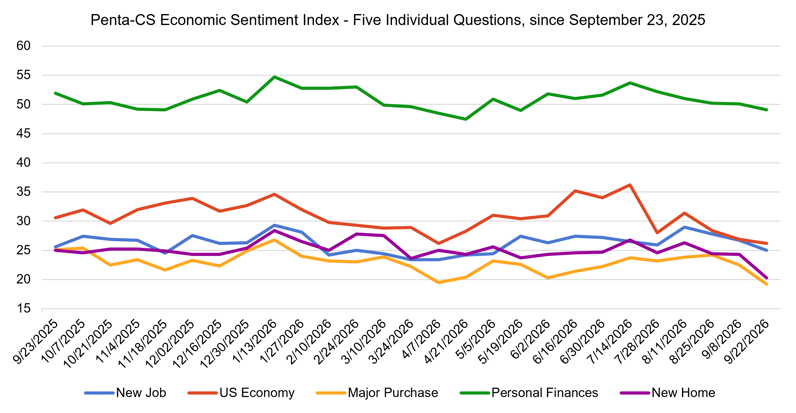
 All of the ESI's five indicators decreased during this period. Confidence in buying a new home decreased the most, falling 4.0 points to 20.3.
—Confidence in making a major purchase decreased 3.3 points to 19.2.
—Confidence in finding a new job decreased 1.7 points to 25.0.
—Confidence in personal finances decreased 1.0 point to 49.1.
—Confidence in the overall U.S. economy decreased 0.7 points to 26.2.
On September 16, the Federal Open Market Committee (FOMC) voted unanimously to raise the target range for the federal funds rate by a quarter percentage point, to 3.75–4 percent. The increase was the Fed's first since July 2023. The committee said that inflation remains elevated and that the hike would support a timelier return to its 2 percent goal. Projections released the same day showed 16 of 18 participants expecting another increase this year. This excludes Fed Chair Kevin Warsh, who has declined to submit a projection of his own since taking the role.
Inflation data earlier in the period underscored the challenge facing the Fed. The Bureau of Labor Statistics (BLS) reported that the August Consumer Price Index (CPI) increased 3.4 percent year-over-year, while core CPI, which excludes volatile food and energy prices, rose 2.4 percent. Gasoline prices, which were 27.4 percent higher than a year earlier, accounted for more than a third of the monthly increase. The Producer Price Index (PPI) also rose 5.4 percent over the same period, led by energy prices, which were 24.4 percent higher than a year earlier. Despite this, consumer spending held up in August. The Census Bureau reported that retail and food services sales increased 1.2 percent during the month and 6.0 percent from a year earlier, rebounding from a revised decline in July, though the estimates are not adjusted for inflation and part of the increase reflects higher gasoline prices.
The bond market also reflected mounting inflation concerns during the period, with the benchmark 10-year Treasury yield briefly touching 5.04 percent on September 15, its highest level since 2007. This came amid a broader global bond selloff as surging oil prices raised fears of renewed inflationary pressure, with the conflict in the Middle East nearing its seventh month. Brent crude climbed to roughly $99 per barrel on September 8 following reports of a second Iranian attack on U.S. Navy ships, and remained near or above $100 for much of the period as disruptions to supply limited exports.
Mortgage rates also increased during the period, adding to affordability challenges for prospective homebuyers. Freddie Mac reported that the average 30-year fixed mortgage rate rose to 6.95 percent during the week ending September 17, its highest level of 2026 and up from 6.76 percent the previous week and 6.26 percent a year earlier.
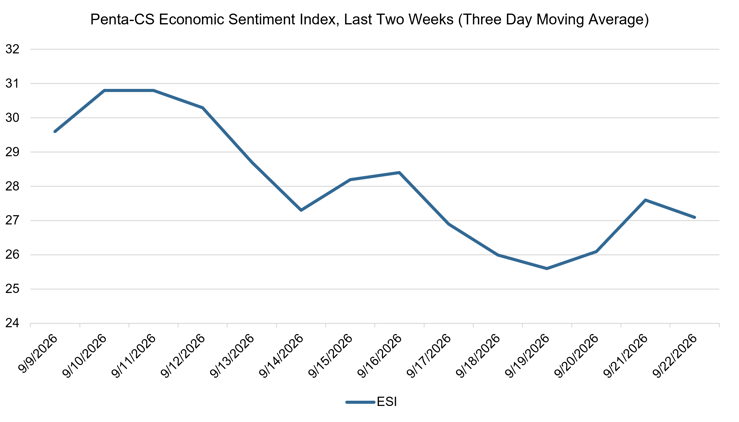
The ESI's three-day moving average declined overall over the two-week period, despite a late rebound. It began at 29.6 on September 9 before rising to a high of 30.8 on September 10. It then fell, reaching 27.3 on September 14 before briefly recovering to 28.4 on September 16. The three-day moving average then declined to a low of 25.6 on September 19 before climbing to 27.1 on September 22 to close out the session.
The next release of the ESI will be on Wednesday, October 7, 2026.
Note: The previous ESI release on September 9 has been corrected due to a system reporting error affecting the underlying data.