.png?width=284&height=80&name=Penta_Logo_1CBD83%201%20(1).png)
 March 11, 2026
 Penta
Penta
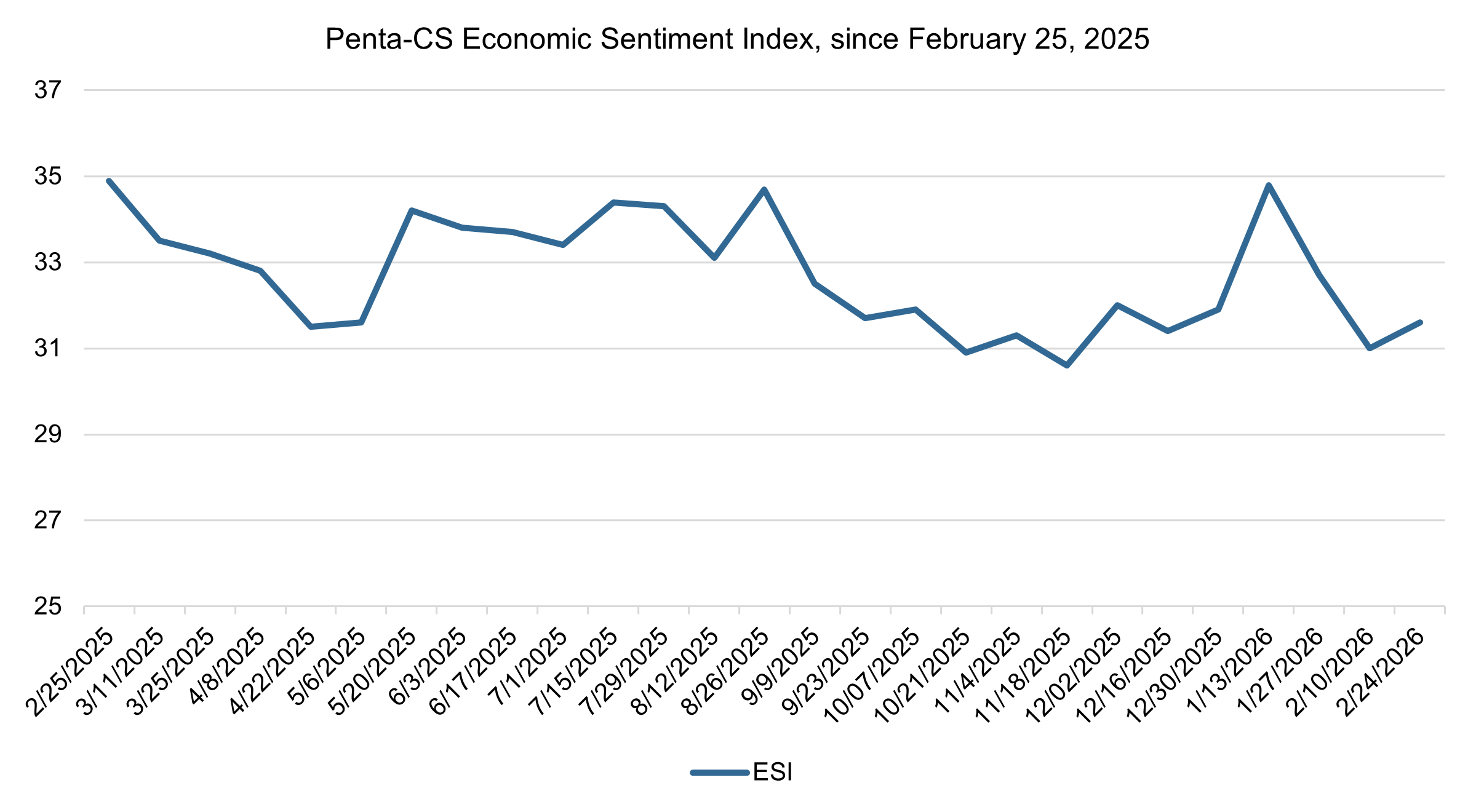
The latest biweekly reading of the Penta-CivicScience Economic Sentiment Index (ESI) fell by 0.7 points to 30.9, erasing the prior period's gains and hovering near its one-year low.
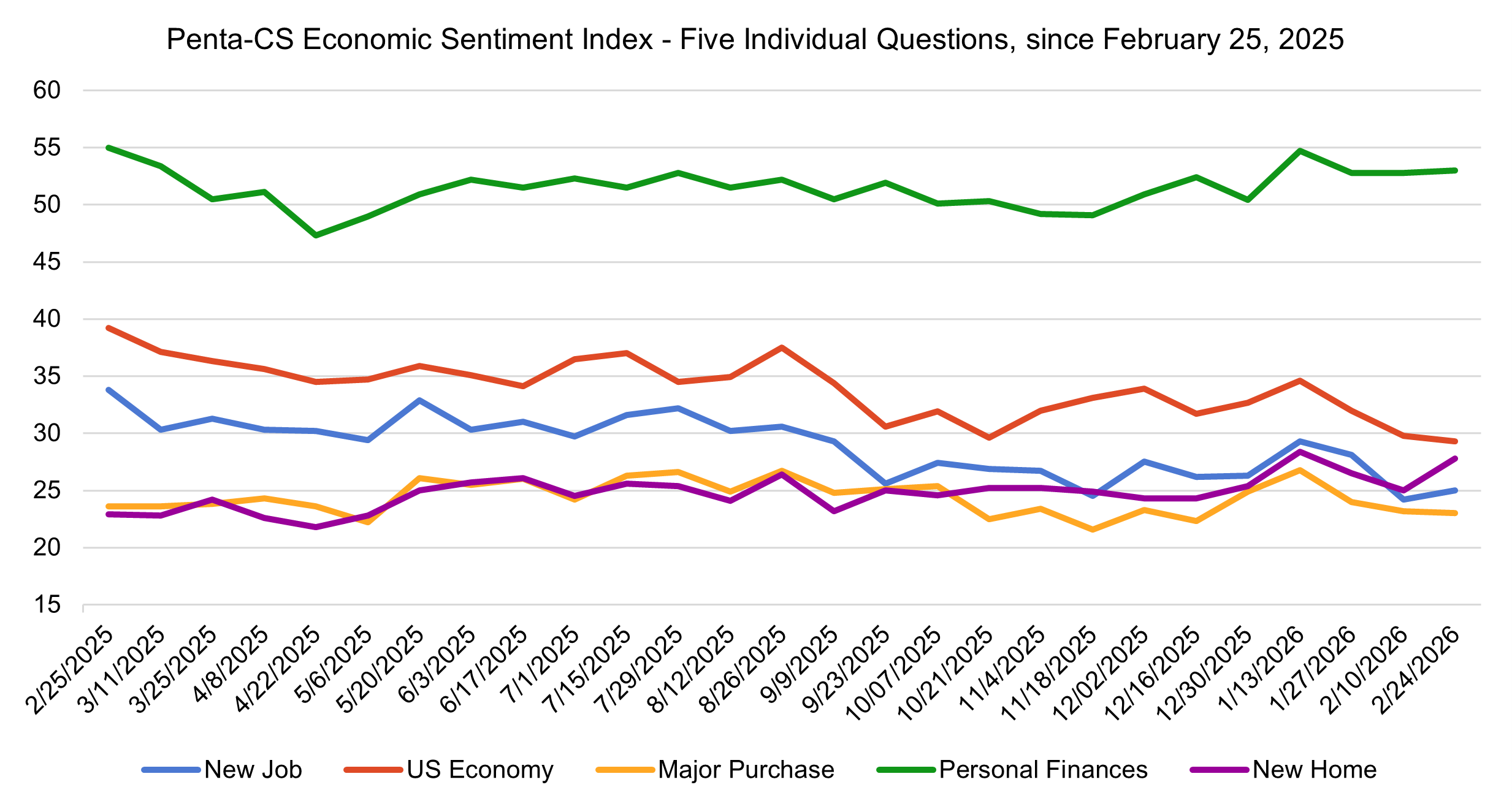
Four of the ESI's five indicators decreased during this period. Confidence in personal finances decreased the most, falling 3.1 points to 49.9. This marks this indicator's largest decline since April 2025.
—Confidence in finding a new job decreased 0.6 points to 24.4.
—Confidence in the overall U.S. economy decreased 0.5 points to 28.8.
—Confidence in buying a new home decreased 0.3 points to 27.5.
—Confidence in making a major purchase increased 0.9 points to 23.9.
The February Jobs Report showed that total nonfarm payroll employment fell by 92,000, largely driven by strike-related losses in the health care sector. The decline was worse than expected. Economists surveyed by The Wall Street Journal had projected a gain of 50,000 jobs. The unemployment rate also ticked up to 4.4 percent. Diane Swonk, chief economist at KPMG U.S., stated that this report "illustrates how fragile the economy is on the labor market side," and that "the labor market weakness that we had seen emerge last year has not completely abated." This report also raises fresh questions about whether the Federal Reserve will adjust interest rates in order to uphold its dual mandate to promote maximum employment and stable prices.
Similarly, the Fed published the latest edition of the Beige Book, a collection of anonymous anecdotes from businesses and economic experts across the country summarizing local economic conditions in each of the Fed's 12 districts. In February, seven districts reported slight to moderate economic growth, while five saw flat or declining activity. Labor markets were generally stable across seven of the districts, while wages rose in most districts and prices increased across all 12.
Additionally, the Bureau of Labor Statistics (BLS) reported that the Producer Price Index (PPI), a measure of wholesale inflation, increased 0.5 percent in January and 2.9 percent year-over-year. Excluding food, energy, and trade services, the index rose 0.3 percent for the month. Evidence of sustained rise in input costs for materials, transport, and labor across production chains could reinforce a cautious approach from the Fed as it weighs its next interest rate decisions.
Finally, oil prices are rising after the U.S. and Israel launched airstrikes against Iran. The conflict has caused disruption to the global energy market, with oil prices surging past $100 per barrel and retail gasoline prices jumping to $3.45 per gallon on March 9. Depending on how this conflict progresses, persistent volatility could further raise oil and gas prices and overall inflation. Patrick De Haan, head of petroleum analysis at GasBuddy, estimates that "the chance of the national average reaching $4 per gallon in the next month is now 80 percent."
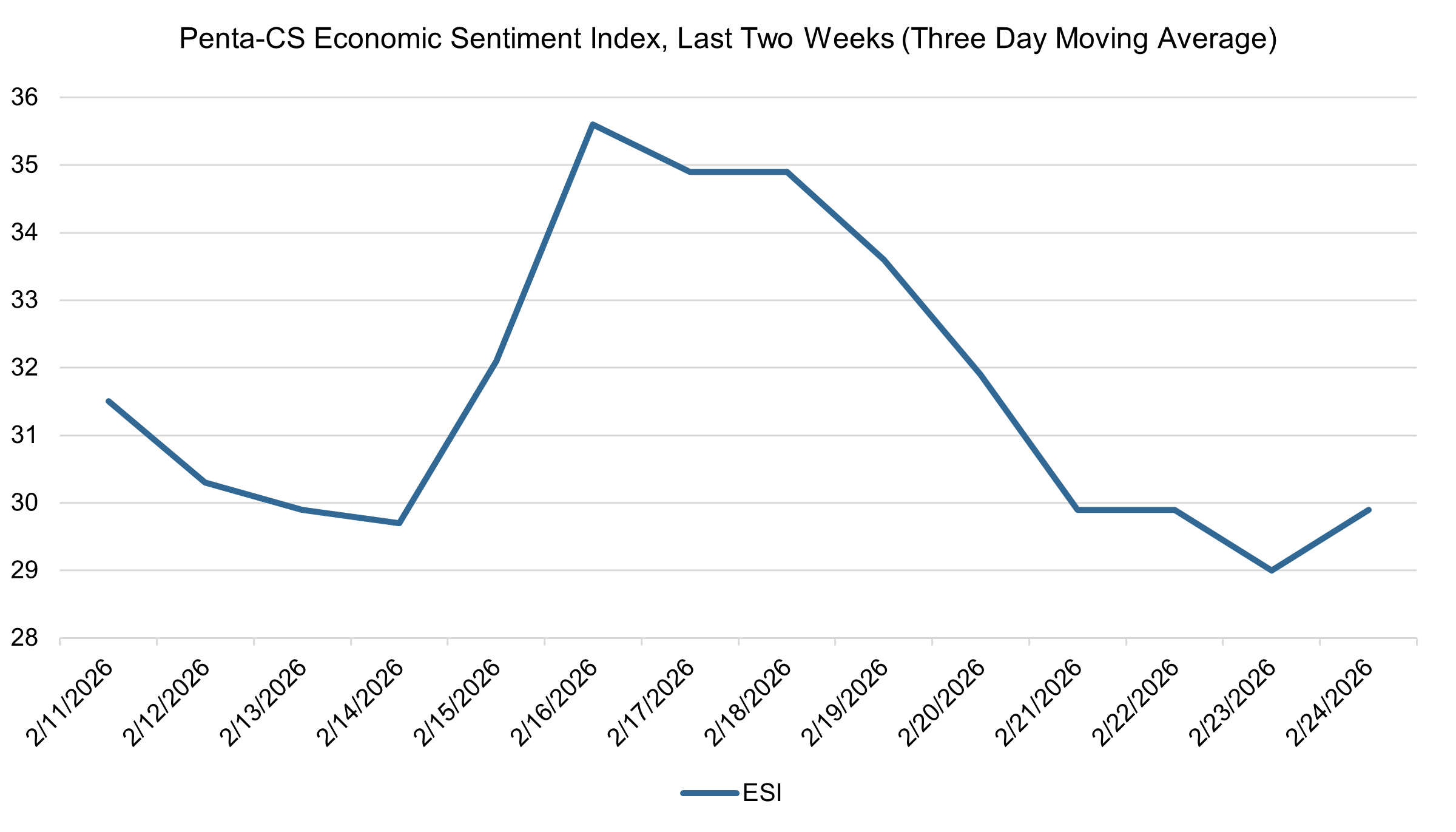
The ESI's three-day moving average began this two-week stretch at 29.8 on February 25. It then oscillated between increasing and decreasing, rising to a high of 32.5 on March 3 before falling to a low of 28.2 on March 8. The three-day moving average stayed at 28.2 on March 9 before rising to 30.6 on March 10 to close out the session.
The next release of the ESI will be on Wednesday, March 25, 2026.