.png?width=284&height=80&name=Penta_Logo_1CBD83%201%20(1).png)
 January 14, 2026
 Penta
Penta
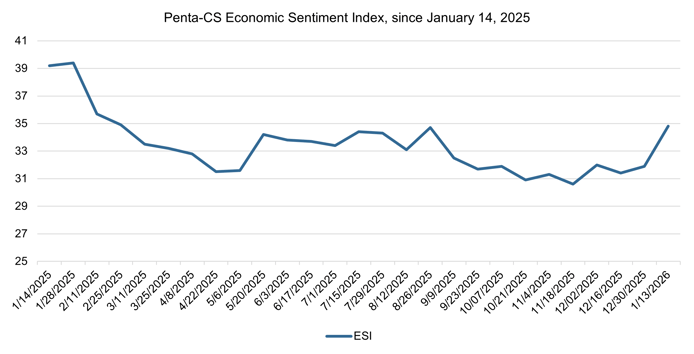
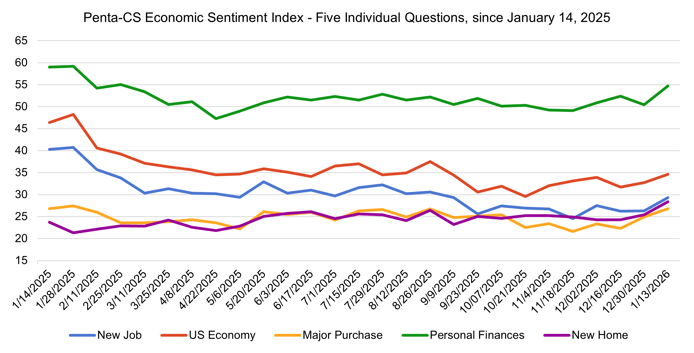
All five ESI indicators increased during this period, building on gains posted by four of the five indicators in the prior period. In this period, confidence in personal finances increased the most, rising 4.3 points to 54.7.
—Confidence in finding a new job increased 3.0 points to 29.3.
—Confidence in buying a new home increased 3.0 points to 28.4.
—Confidence in making a major purchase increased 1.9 points to 26.8.
—Confidence in the overall U.S. economy increased 1.9 points to 34.6.
The Bureau of Labor Statistics (BLS) released the December Consumer Price Index (CPI), showing that inflation rose 0.3 percent during the month and 2.7 percent year-over-year. This increase was primarily driven by shelter costs, which rose 0.4 percent in December. These data were relatively in line with November's CPI, which showed that inflation increased 0.2 percent during the month and 2.7 percent annually. However, economists warned that inflation may have been understated in the November report due to collection issues during the shutdown.
The BLS' December Jobs Report showed that total nonfarm payroll employment increased by only 50,000 during the month, driven by increases in food services and drinking places, health care, and social assistance. Meanwhile the unemployment rate fell to 4.4 percent. Over the course of 2025, the economy added 584,000 jobs, or around 49,000 per month. In contrast, the economy added around 168,000 monthly jobs in 2024. Outside of the two most recent recessions, 2025 has recorded the slowest average monthly job growth in more than two decades.
Data from Freddie Mac showed that the average 30-year mortgage rate fell to a one-year low of 6.15 percent in the week ending December 31, offering modest relief to homebuyers heading into the new year. Yet with 30 million households, or 54 percent of primary mortgage holders, locked into rates at or below 4 percent, homeowners remain disincentivized to sell, suppressing housing market activity.
The Bureau of Economic Analysis released its initial estimate for gross domestic product (GDP) for the third quarter of 2025 which showed that real GDP increased 4.3 percent from July to September, coming in well-above economists' predictions of 3.2 percent, primarily boosted by strong consumer spending. The report, which was initially set to be released on October 30 but delayed due to the government shutdown, points to surprising resilience in the economy despite persistent inflation.
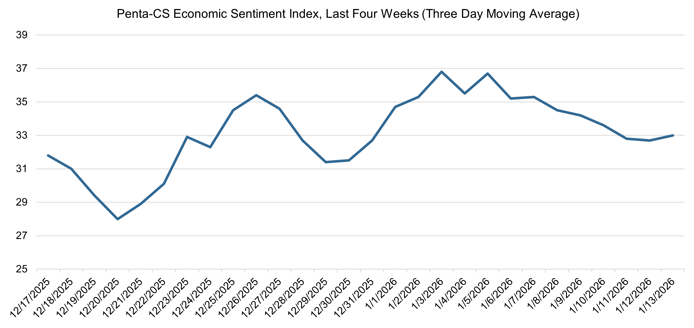
The past four weeks have been marked by fluctuations in the ESI's three-day moving average. The moving average began at 31.8 on December 17. It then decreased to a low of 28.0 on December 20 before trending upward to 35.4 on December 26. The three-day moving average then fell again, decreasing to 31.4 on December 29 before increasing to a high of 36.8 on January 3. Finally, the three-day moving oscillated between increasing and decreasing, ultimately closing out the past four weeks at 33.0 on January 13.
The next release of the ESI will be on Wednesday, January 28, 2026.