.png?width=284&height=80&name=Penta_Logo_1CBD83%201%20(1).png)
.png)
 July 29, 2026
 Dan La Russo
Ask Washington policymakers what they fight about, and AI makes the list. Ask them what they might actually work together on, and AI tops it.
That’s worth pausing on if you’re building a 2026 AI strategy. On the surface, it is easy to treat AI like every other polarized issue: pick a side, wait for the midterms, and let the election direct your strategy.
But a deeper look at what elected officials are doing, not just what they say, will indicate that is not a sound approach.
The coalitions are still forming, and the party lines haven’t hardened, so the next few months present a unique window to shape this before November draws the map.
On the physical questions like where a data center gets sited, what it does to a utility bill, and whether a state hits pause on the industry, the parties are more aligned than they are apart.
The abstract questions like whose job it is to address the challenges AI brings, how much to trust companies versus government, and how AI will impact employment are where the gaps seem to widen.
Those unique splits are worth exploring now: both parties believe something big should happen on AI.
What they don’t yet share is a theory of what that “something” is, and that gap is where the opening sits.
The scoreboard says divided. Washington disagrees.
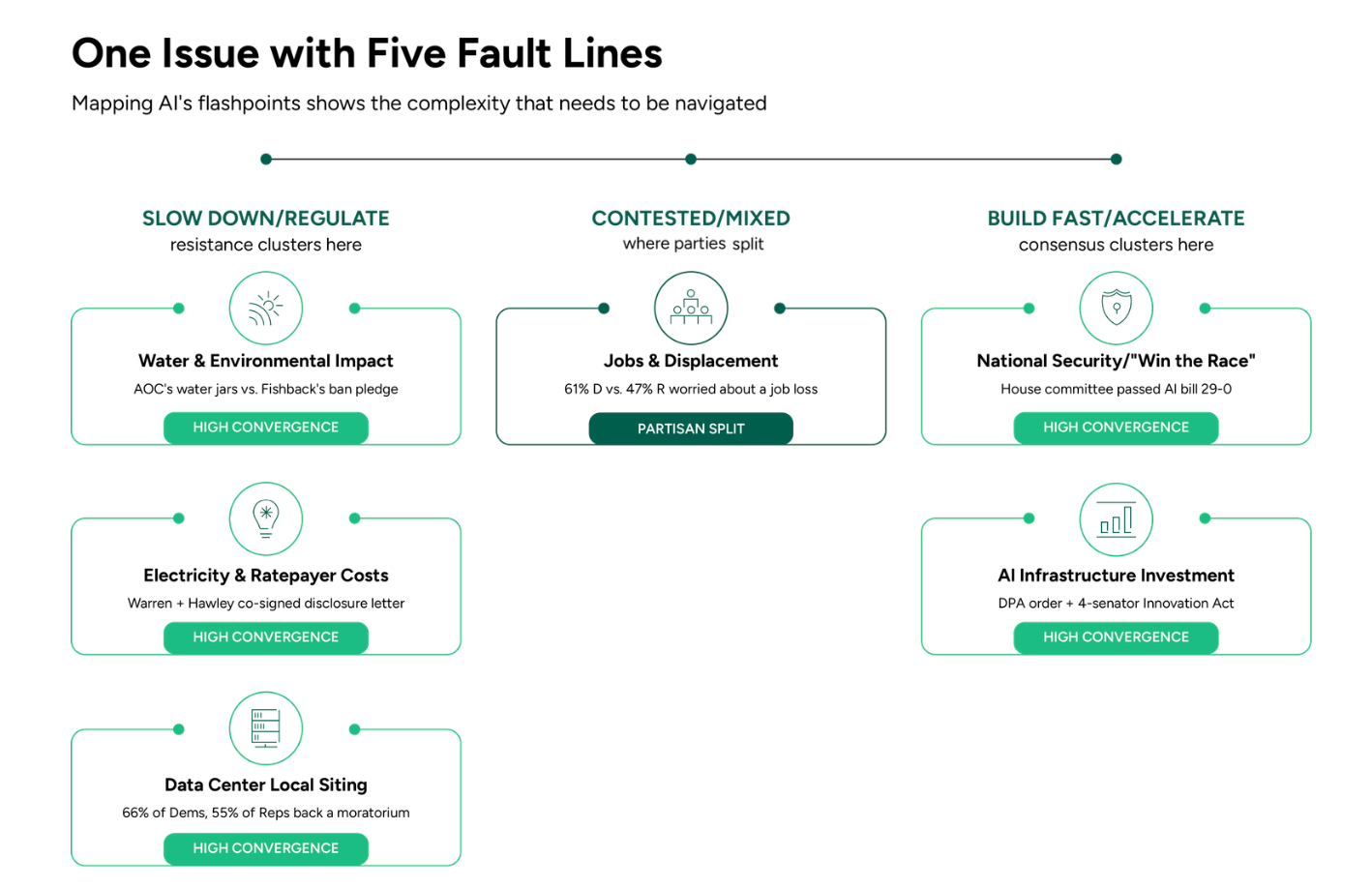
In June, Elizabeth Warren and Josh Hawley co-signed a letter demanding data centers disclose their energy use: a progressive and a populist Republican taking joint action, not just parallel opposition. The same month, a House committee passed an AI security bill 29-0. Four senators from both parties, Maria Cantwell, Todd Young, John Hickenlooper, and Marsha Blackburn, are co-sponsoring the Future of AI Innovation Act to keep the U.S. ahead of China on AI. None of that fits a clean red-versus-blue map.
These pairings are early-stage and issue-specific, not a settled policy consensus. Warren and Hawley agree that data centers should disclose their energy use, not on what regulation should follow. The 29-0 committee vote and the four-senator China bill fit the same pattern: they are coalitions of convenience that could easily fracture once the conversation moves from disclosure to enforcement.
Where the convergence really is
Split the physical from the abstract, and the pattern comes into focus. On the ground — water, electricity, where a data center actually gets built — both parties are in the same place, just arriving from different directions.
When Ocasio-Cortez criticizes data centers for how much water they use, she's aiming at the same target as James Fishback — the Republican running for Florida governor — when he calls for a build ban, even if the politics look opposite. Two-thirds of Democrats and a majority of Republicans (66% and 55%, per Heatmap News) now back a national data center moratorium. Republican governors who once recruited this industry are now the ones seemingly pumping the brakes. The same holds on the accelerate side: a Defense Production Act order fast-tracking AI infrastructure and the Future of AI Innovation Act are both aimed at outpacing China and are moving with cross-party support — proof “build fast” unites the parties just as much as “slow down” does.
Move to the abstract questions like who's responsible for fixing this, how much to trust government versus companies, whether AI costs you your job, and the gap reopens. Unlike the physical questions around the grid, water use, and communities that the data center dialogue prompts, job displacement is a diffuse, forward-looking concern about AI replacing work in general — a kind of anxiety is sorting by party. It’s unclear in this moment exactly what the impact of AI on jobs will be, who is impacted, and what kind of private or public sector support should enter the mix.
 Sources: The Politics of AI ; Most Americans Want a National Data Center Moratorium
The gap, measured
The partisan gap across the five areas with a high degree of convergence — water, electricity/utility, siting, national security, infrastructure investment — holds remarkably steady at 11 to 14 percentage points. It's 11 on data center siting (Heatmap News) and 11 on who's to blame for rising electricity costs (Pew Research Center), 12 on requiring safety review before releasing new AI models (AI Policy Institute, via NBC News), 13 on trust in government to regulate any of it (Pew Research Center), and widest at 14 on personal job-loss worry (Reuters/Ipsos).
But those gaps also present openings on these issues, which are still very early in their arcs and evolving rapidly. The ratepayer bills and safety-review debates are already in motion regardless of who controls the next Congress; the preemption fight — the question of whether a federal AI law overrides the patchwork of state rules now emerging from California and Colorado — may be the one piece that actually forces a decision. A GOP-led Congress would give federal preemption of state AI laws its best shot, while a Democratic one likely leaves the states as a battleground.
The organizations that understand these rapidly evolving issues and engage now, while the lines are still this blurry, will have an advantage. The ones waiting for November to tell them who's “right” on AI risk having the map already drawn without them.